The Case for New Ways of Working
How to get things to go better and to be more productive, is a key challenge for business in the 21st century. The UKs productivity has nearly ground to a halt since 2008. This is a measure of how much is done or made per hour which results in how much workers can earn. Many other countries are more productive that the UK. The US, Japan and most of Europe are increasing productivity faster than us. Improving productivity is a goal being set at the highest levels.
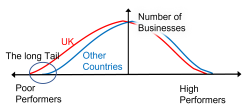
It is believed that a big part of the problem is a "Longtail" of underperforming businesses. On a distribution curve of performance, at one end will be UK businesses that do the best, in the middle - where there will be most - are the ones doing adequately and on the other end are the poor performers, tapering off too increasing mediocrity, this is the long tail. Compared to other countries we have more on this tail.
A recent report commissioned by the Hunter foundation and carried out by Oxford economics, Raising Scotland's economic growth rate , looked at the economic challenges facing Scotland. They found:
- The Scottish economy to be more highly concentrated in low productivity sectors and less concentrated in advanced services such as information & communications, professional, scientific & technical services, and financial services when compared to the UK average.
- The proportion of Scottish businesses that were innovation-active fell between 2016 and 2018, despite the existence of a good higher education research and development sector.
- Scotland does not utilize the skills of it's workforce as well as it could, with mismatches between the skills that workers have and those that their jobs require. Almost one in five graduates work in non-graduate roles and 35% of employers say they have over-qualified or over-skilled employees.
- Despite this relatively well-educated population, they cited studies that point to poor levels of management skills in Scotland.
These challenges are broadly the same as other regions of the UK outside London, and the authors see no reason why an independent Scotland could not theoretically succeed in raising to them.
How good is your business really? Raising our ambitions for business performance from the Productivity Leadership Group details the causes of the UK's productivity stagnation, these are:
- That many British businesses are poor at adopting best management practice.
- Many rest content with current products and working practices, rather than seeking to innovate.
- Too few think long term about talent.
- Too much focus on short-term survival and success, at the expense of long-term value creation.
According to the Productivity Leadership Group, Ambitions British business should have, are in digital connectivity, embracing the need for change, in leadership and, collaboration. A lack of any one of these factors is what puts some businesses out on that statistical long tail of poor management.
It is now established that the adoption of digital technologies is one significant way increase productivity. This is one of the things many businesses north and south of the boarder are specifically failing to do. A clear business case is established for leaders committing to, and implementing, lasting changes in the way they do business, including a greater use of digital technologies.
Read More
Raising Scotland's economic growth rateApril 2021
How good is your business really? Raising our ambitions for business performance
September 2017 - Retrieved May 2021
The Solow Paradox - and how it's been solved.
April 2015
May 2021
 | Duncan Stonebridge.
Back
| Duncan Stonebridge.
Back